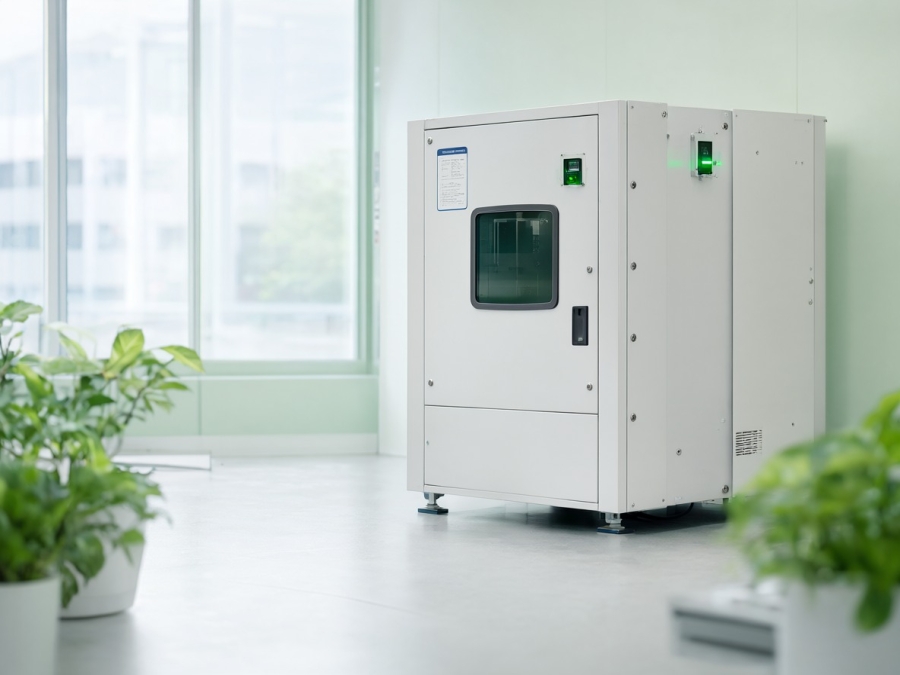
With "carbon neutrality" and green manufacturing championed worldwide, industrial laboratories and testing bodies face major pressure to save energy and cut emissions. A temperature and humidity chamber is a high-power device that runs continuously for long periods, and the traditional "big power draw, hard balancing" design can no longer meet modern green-lab standards. This article looks at the green evolution of modern chambers in technology, hardware and control algorithms from a low-carbon perspective.
To hold tight temperature and humidity tolerances, traditional chambers ran the refrigeration unit at full power while large heaters cancelled the excess cooling — a huge waste of electricity. To break this bottleneck, modern green chambers have made several core design changes:
- Electronic expansion valves with adaptive cooling-capacity control: modern units replace capillary tubes or thermostatic expansion valves with electronic expansion valves. Working with advanced controllers, the system precisely and dynamically meters refrigerant flow to match the actual thermal load — "only as much cooling as needed, only as much power as used" — leaving the old heating-versus-cooling battle behind.
- New inverter compressors: with inverter technology the compressor no longer starts and stops frequently but adjusts speed to the gap between chamber and setpoint. During long steady-state phases (e.g. the 85/85 damp heat test) it runs smoothly at low frequency, cutting total energy use by 30–50%.
- Waste-heat recovery: compressor discharge carries large amounts of waste heat. Green designs add plate heat exchangers to recover it for the heating system or to pre-heat the humidification water tray, sharply reducing electric-heater energy.
- Full switch to low-GWP refrigerants: in line with the Kigali Amendment to the Montreal Protocol, modern chambers are phasing out high-GWP (global warming potential) legacy fluorocarbons in favour of lower-GWP refrigerants such as R448A, R449A or CO2, reducing the greenhouse impact at the source.
Beyond manufacturer hardware innovation, lab users can also run chambers low-carbon through scientific scheduling and operation:
- Optimise test scheduling (sensible time-slotting): temperature-transition phases consume the most energy, so group specimens with the same temperature range and standard to cut the number of ramp cycles.
- Shift loads to off-peak night tariffs: for damp-heat tests running tens or hundreds of hours (e.g. damp-heat stability tests), start them in the cheap off-peak night window — cutting electricity bills and easing grid load.
- No blind "over-spec" chasing: set parameters strictly from product standards. If the standard only requires -40°C, do not run the chamber to its -70°C limit — compressor energy use grows exponentially as temperature drops.
- Check door airtightness regularly: inspect and replace silicone door seals on schedule. Leaky doors cause frosting, spoil tests and let heating or cooling escape, forcing compressors and heaters into long overload runs and spiking energy use.
Sustainability is no longer a slogan but part of a company's core competitiveness. Moving temperature and humidity chambers toward "green energy saving" cuts long-term electricity and maintenance costs, and is the testing industry's inevitable response to the low-carbon economy. The future of reliability testing will pair precision with sustainability.