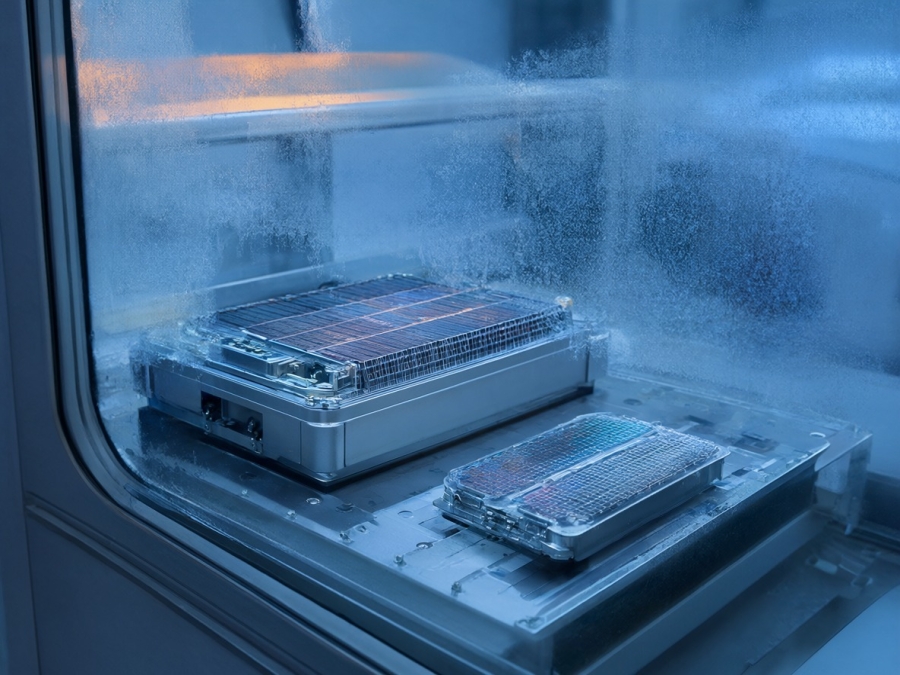
Against a backdrop of rapid technological change, the temperature and humidity chamber is no longer a routine instrument in the QC lab but a core R&D tool driving new-energy vehicles, third-generation semiconductors and 5G communications toward maturity. As product use-cases grow more extreme, environmental reliability testing is evolving toward "higher precision, combined stresses and dynamic profiles". This article examines the demanding test standards chambers face in these two hot industries and the key technology breakthroughs in the equipment itself.
EV traction batteries and semiconductor chips are extremely sensitive to temperature and humidity swings. To keep these core components safe and stable across their whole life cycle, chambers must help companies complete these representative international and national standard tests:
- The 85/85 damp heat test for new-energy batteries: under IEC 61215 and automotive-grade standards, battery assemblies or on-board electronics run continuously for over 1,000 hours at 85°C and 85% RH. This stresses material humid-heat ageing, enclosure sealing and resistance to electrochemical corrosion.
- Temperature cycling for semiconductor chips: per JESD22-A104, chips undergo rapid temperature cycling (e.g. -40°C to 125°C) inside the chamber, generating thermal stress that accelerates the exposure of cracks and poor contacts in die attach, wire bonding and mould compound caused by CTE (coefficient of thermal expansion) mismatch.
- On-load cyclic damp-heat testing for vehicle systems: per GB/T 2423.4, specimens cycle between temperature (25–55°C) and humidity (93–98%) while powered and operating. The chamber must cancel real-time thermal load, holding precise temperature even as the specimen self-heats.
To meet these ever harsher and more varied standards, modern chambers have achieved several breakthrough design and manufacturing advances:
- Smart coordination of inverter compressors and electronic expansion valves: traditional chambers used balance-of-heat-and-cooling control — refrigeration at full power cancelled by big heaters, at huge energy cost. New-generation units use inverter technology plus electronic expansion valves to trim refrigerant flow, actively adjust cooling capacity, and save over 30% energy while improving control accuracy.
- Aerodynamic optimisation of the duct design: single-duct circulation easily creates dead zones. Modern chambers use multi-blade centrifugal fans with multi-hole louvered outlets and multi-dimensional forced convection, keeping temperature-humidity uniformity at top-of-industry levels even when the working volume is packed with specimens.
- IoT remote monitoring and data traceability: new controllers integrate IoT modules. Engineers can view temperature-humidity curves and modify test programs from phone or PC without standing in the lab. Test data are automatically encrypted, stored and reported in tamper-proof form, integrating cleanly with ERP or MES systems.
In practice, building a reliability test platform and running these standards requires configuring and operating the equipment with disciplined engineering logic:
- Match an industry-specific protection matrix: for lithium-battery testing, customise the safety and explosion-protection system at selection time: explosion-proof door locks, pressure relief valves, inert-gas injection ports and combustible-gas (e.g. CO) monitoring interlocks.
- Micron-level water purification for the supply system: humid-heat testing is demanding on water quality. Fit a dedicated purifier to raise humidification water resistivity above 500 Ω·m, preventing scale on humidifier tubes and wet-bulb sensors and eliminating the industry's chronic "false 100% humidity" fault.
- Dynamic power calibration for on-load tests: before an on-load test, enter the specimen's powered heat output (W) into the controller's load-compensation system so the chamber pre-adjusts compressor output and avoids temperature overshoot when the specimen powers on.
- Life-cycle metrological calibration: as a legally controlled metrology instrument, the chamber must be periodically calibrated on site for deviation, fluctuation and uniformity by an accredited body (e.g. the National Institute of Metrology), so test reports carry internationally recognised legal standing.
In summary, the temperature and humidity chamber is far more than a "hot-and-cold steel box" — it is a complex high-end system integrating refrigeration engineering, precision micro-control, mechanics of materials and industrial IoT. Through continuous in-house technology evolution, it is building an unbreakable data defence line for the high-quality rise of hard-tech industries such as new energy and semiconductors.