As global manufacturing demands ever higher product quality, safety and durability, environmental reliability testing has become an indispensable step before product development and mass production. The temperature and humidity chamber — the "evergreen" of environmental test equipment — artificially reproduces extreme climates rarely met in nature. This article analyses this core test instrument from three angles: underlying operating principles, multi-industry applications and scientific daily maintenance.
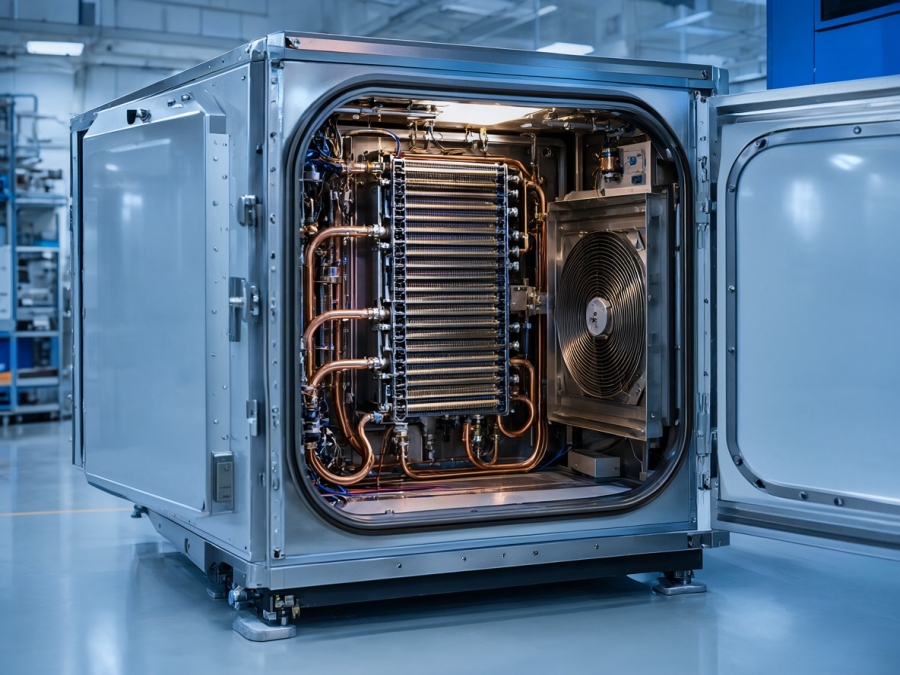
To get the best from a temperature and humidity chamber, first understand how its internal systems cooperate to control temperature and humidity precisely. The equipment consists of five core systems:
- Refrigeration system: usually cascade mechanical compression refrigeration. Environmentally friendly refrigerants (e.g. R404A, R23) vaporise in the evaporator and absorb heat, rapidly lowering chamber air temperature. For ultra-low temperatures (e.g. -70°C), dual-unit cascade refrigeration is the key to achieving both ramp rate and ultimate temperature.
- Heating system: mainly nickel-chromium electric heating elements. When the controller detects the chamber below setpoint, the PID controller sends pulse signals to a solid-state relay, generating heat that is distributed evenly through the air ducts into the working volume.
- Humidification & dehumidification system: humidification typically uses steam injection or a heated shallow water tray; dehumidification relies on mechanical refrigeration, condensing moisture from the warm humid air on evaporator coils operating below dew point and draining it away.
- Air-circulation system: a multi-blade centrifugal fan rated for extreme temperatures plus a specially designed duct network. It forces convection of the energy produced by heaters and evaporators, keeping temperature-humidity deviation in every corner of the working volume within national-standard tolerances.
- Control system: the chamber's "brain". Modern units use programmable microcomputer controllers that not only run complex PID calculations but also coordinate cooling, heating and humidification according to multi-segment user programs, achieving high-precision balance temperature and humidity control (BTHC).
With such strong climate-simulation capability, temperature and humidity chambers are used across virtually every high-tech and traditional manufacturing industry:
- Electronic components & semiconductors: tests leakage current, insulation resistance and chemical corrosion of chips, ICs and capacitors under cyclic damp heat, predicting service life.
- Automotive & rail transit: vehicle electronics, on-board instruments, wiring harnesses and even complete vehicle lamps must endure dozens of freeze-bake cycles in the chamber to prove they will not freeze up or crack in regions as cold as Mohe or as scorching as Turpan.
- Aerospace & defence: airborne equipment and weapon components must survive even harsher thermal shock; the chamber simulates the extreme alternation of high-altitude low-pressure cold and ground-level hot-humid conditions.
- New materials & new energy: the physical degradation of PV modules, lithium batteries and new composites under prolonged humid heat (reduced peel strength, yellowing, capacity fade) is a key basis for assessing outdoor service life.
A temperature and humidity chamber is a high-precision, high-power electromechanical system; heavy test duty inevitably wears internal components. To extend equipment life and keep data accurate, companies must establish strict daily maintenance routines:
- Humidification water and water-line management: use only purified, distilled or deionised water. Never tap water — calcium and magnesium ions scale up the humidifier and sensors, burning out humidifier tubes or causing humidity display faults. Flush the tank and water lines weekly.
- Regular replacement of the wet-bulb cloth: humidity is measured by the wet-and-dry-bulb method. A dirty, hardened or 3-months-old wet-bulb gauze severely reduces wicking and can drive the humidity reading to 100% or cause large deviations, so replace the dedicated test gauze on schedule.
- Periodic condenser dusting: air-cooled condensers collect dust easily, causing poor heat rejection, compressor high-pressure trips and even damage. Thoroughly clean condenser fins with a vacuum cleaner or compressed air every three months.
- Over-temperature protector function check: every chamber has a mechanical over-temperature protector independent of the main controller. Before each test, confirm its setpoint is about 10–20°C above the maximum test temperature, and trigger it manually on a regular basis to verify it cuts power during abnormal overheating, protecting the specimen from burnout.
- Moisture purge for long shutdowns: if the equipment will be idle for a long time, run a high-temperature (e.g. 60°C) drying program for about 2 hours before shutdown to drive all moisture out of the working volume and ducts, then cut main power and cover the chamber with a dust cover.
In summary, a temperature and humidity chamber is not only the "touchstone" that proves product quality but also a core asset in a company's innovation process. Understanding its working principles, standardising test practice and practising fine daily maintenance maximises equipment life and provides solid, reliable data support for products entering global markets.